

Tuesday, 6 January 2015

Wednesday, 31 December 2014
St Melania

St Melania (383- 439)
St Melania whose feast day is December 31st. Melania was born to wealthy Christians, Publicola, a Roman senator, and Albina. At fourteen, she was given in marriage to Valerius Pinianus. When two of her children died soon after childbirth, her husband agreed to lead a life of continency and religious dedication. In 417 all three made a pilgrimage to the Holy Land and settled at Jerusalem, where Melania became a friend of St Jerome. After the death of her mother in 431 and her husband in 432, Melania attracted disciples to her solitary way of life and built a convent, for which she was Abbess until her death on December 31st, 439. The life of St Melania reminds us of the fleeting character of earthly wealth. We should strive to emulate her use of wealth as well as talents to further the cause of Our Lord and Saviour Christ.
Saturday, 13 December 2014
St Lucy

Virgin martyr and saint (283 - 304).
Lucy was well known for her beautiful eyes. It was said that her eyes radiated her love for Christ. During her torture by the Romans, Lucy’s eyes were gouged out and God restored her sight and eyes. She is one of eight women, who along with the Blessed Virgin Mary, are commemorated by name in the Canon of the Mass. Her feast day is celebrated on December 13th. Saint Lucy of Syracuse was honoured in the Middle Ages and remains a much loved saint in Western Europe.
Sunday, 30 November 2014

Saturday, 22 November 2014
Saint Cecilia

Today the Church celebrates the memorial of St Cecilia, virgin and martyr. St Cecilia is one of the most famous and most venerated of Roman martyrs. Her body was discovered in 822 and transferred to the title church that bears her name in Trastevere in Rome. It is difficult to determine the date at which she lived. The legend which recounts the Saint's martyrdom and that of her husband St Valerian, as also of St Tiburtius, her brother-in-law, places her martyrdom in the pontificate of Urban I (222-230); but the authenticity of this account cannot be established, nor can we be sure of the persons who suffered with her nor of the date of her martyrdom.
Saint Cecilia
Cecilia was so highly venerated by the ancient Roman Church that her name was placed in the Canon of the Mass. Already in the fourth century there was a church of St Cecilia in Trastevere, erected on the site where her home had stood. Her martyrdom probably occurred during the reign of Emperor Alexander Severus, about the year 230. In 1599 her grave was opened and her body found in a coffin of cypress wood. It lay incorrupt, as if she had just breathed forth her soul. Stephen Maderna, who often saw the body, chiselled a statue that resembled the body as closely as possible. Since the Middle Ages, Cecilia has been honoured as patroness of Church music, a practice having its source in a false application of a passage from the Office (cantantibus organis).
Apart from the fact of her martyrdom, we know practically nothing about her that is historically verifiable. Among other details the breviary offers the following:
Cecilia led a life of prayer and meditation and had vowed lifelong virginity, but a youth by the name of Valerian, relying upon the approval of her parents, hoped to marry her. When the wedding night arrived, she confided to Valerian, "There is a secret, Valerian, I wish to tell you. I have as a lover an angel of God who jealously guards my body." Valerian promised to believe in Christ if he would be enabled to see that angel. Cecilia explained how such was impossible without baptism, and Valerian consented to be baptized. After he was baptised by Pope Urban and had returned "He found Cecilia in her little room lost in prayer, and next to her the angel of the Lord was standing. When Valerian saw the angel, he was seized with great terror." The angel handed to them a bouquet of fiery red roses and snow-white lilies as a reward for Cecilia's love of chastity, a bouquet that would not wither, yet would be visible only to those who love chastity. As a further favor Valerian besought the conversion of his brother Tiburtius.
 Upon arriving to congratulate the newlyweds, Tiburtius was astounded by the unspeakably beautiful roses and lilies. As soon as he was informed regarding their origin, he too asked for the waters of baptism. "St. Cecilia said to Tiburtius: Today I acknowledge you as a brother-in-law, because the love of God has made you despise the idols. Just as the love of God gave me your brother as a spouse, so it has given you to me as a brother in-law." When Almachius, the prefect, heard of the conversions, he ordered Maximus, his officer, to arrest and imprison all of them. Before being put to death, they instructed Maximus and his family, and baptised them during the night preceding execution.
At dawn Cecilia roused the two brothers to struggle heroically for Christ, as the glow of morning disappeared, Cecilia called: "Arise, soldiers of Christ, throw away the works of darkness and put on the armour of light." Cecilia pursued her victory as the soldiers willingly listened, "We believe that Christ is the true Son of God, who has chosen such a servant." Led before the prefect, she professed her faith in Christ, "We profess His holy Name and we will not deny Him."
In order to avoid further show, the prefect commanded her to be suffocated in the baths. She remained unharmed and prayed, "I thank You, Father of my Lord Jesus Christ, that through Your Son the fire was extinguished at my side." Beheading was next in order. The executioner made three attempts (the law prohibited more) and let her lie in her blood. She lived for three days, encouraging the poor and dedicating her home into a church.
Excerpted from The Church's Year of Grace, Pius Parsch
Patron: Albi, France; composers; martyrs; music; musicians; musical instrument makers; archdiocese of Omaha, Nebraska; poets; singers.
Symbols: Holding a lute; playing the organ; holding roses.
Wednesday, 15 October 2014
St Teresa of Ávila
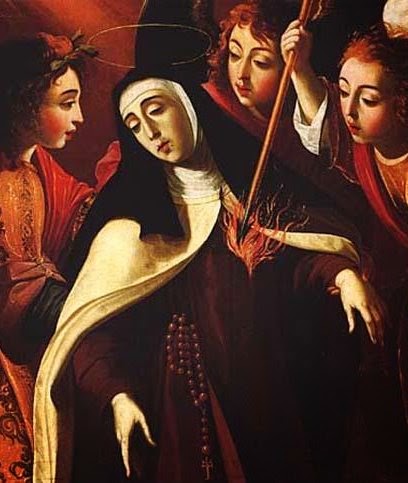
“It is foolish to think that we will enter heaven without entering into ourselves.”
Teresa of Ávila, also called Saint Teresa of Jesus, baptised as Teresa Sánchez de Cepeda y Ahumada (28 March 1515 – 4 October 1582), was a prominent Spanish mystic, Catholic saint, Carmelite nun, an author of the Counter Reformation and theologian of contemplative life through mental prayer. She was a reformer of the Carmelite Order and is considered to be a founder of the Discalced Carmelites along with John of the Cross. Teresa is one of the foremost writers on mental prayer, and her position among writers on mystical theology is unique. In all her writings on this subject she deals with her personal experiences. Her deep insight and analytical gifts helped her to explain them clearly. Her definition was used in the Catechism of the Catholic Church: "Contemplative prayer [oración mental] in my opinion is nothing else than a close sharing between friends; it means taking time frequently to be alone with him who we know loves us." She used a metaphor of mystic prayer as watering a garden throughout her writings. She was misunderstood, misjudged, opposed in her efforts at reform. Yet she struggled on, courageous and faithful; she struggled with her own mediocrity, her illness, her opposition. And in the midst of all this she clung to God in life and in prayer. She founded over a half-dozen new monasteries. She travelled, wrote, fought — always to renew, to reform. In her self, in her prayer, in her life, in her efforts to reform, in all the people she touched, she was a woman for others, a woman who inspired and gave life. In 1970, the Church gave her the title she had long held in the popular mind: Doctor of the Church. She and St Catherine of Siena were the first women so honoured.

Saturday, 4 October 2014
St Francis of Assisi

“A man who works with his hands is a labourer.
A man who works with his hands and his head is a craftsman.
A man who works with his hands, his head, and his heart is an artist.”
― St Francis of Assisi

Subscribe to:
Posts (Atom)